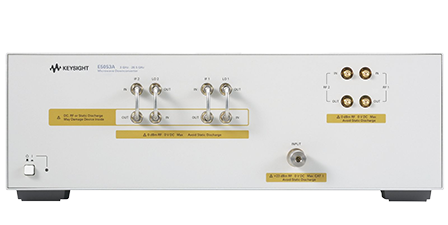


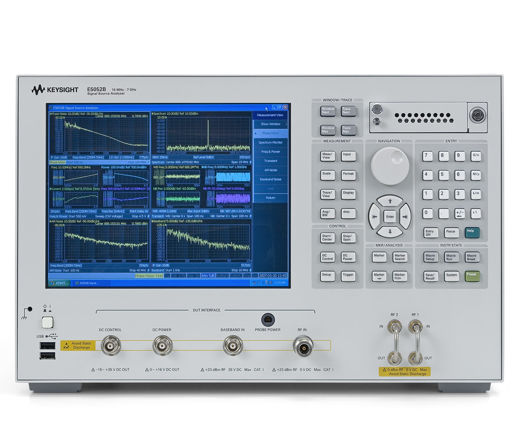
Keysight Technologies E5052B
7 GHz Signal Source Analyzer, Type N (f)
Rent or Lease • Buy Used From $60,000
Keysight Technologies – E5052B
The Keysight Technologies E5052B SSA test set delivers unparalleled performance and versatility across a variety of signal sources and industries from wireless communications to aerospace and defense.
E5052B Product Highlights
- Phase noise measurement with ultra-low noise floor and a cross-correlation method
- Simplifies complicated, time-consuming measurements and dramatically reduces test time
- Multi-window display speeds your measurement evaluation and allows you to view multiple results simultaneously
- Simultaneous transient measurements for frequency, phase, and power over time
- Video trigger function allows capture of unexpected frequency changes
- Evaluates clock jitter in high-speed data communication systems
Keysight Technologies & TRS-RenTelco
TRS-RenTelco is a proud partner of Keysight Technologies and offers a wide range of rental, purchase and leasing solutions designed specifically to meet the evolving needs of the electronic testing industry. Our close relationship with Keysight Technologies allows us to ensure we have the right Network/Impedance Analyzers solution for your job.
Renting Network/Impedance Analyzers
With TRS-RenTelco renting Network/Impedance Analyzers equipment has never been easier. Enjoy same-day shipping, lease, and finance options on our inventory of over 5000 electronic testing equipment rentals. As one of North America’s largest test equipment rental providers, it is our mission to support the endeavors of our clients no matter how big or small with reliable expertise, excellent customer service, accuracy, and speed.
Additional Information
Manufacturer Home Page | Keysight Technologies.
- Configurations
- Resources
- FAQsAI
Base Model
Standard Rental Accessories*
* Leased or Buy Used product accessories will be confirmed with quote.
-
Cord Power
Qty: 1 -
Cable Semi-Rigid SMA(m) - SMA(m)
Qty: 2 -
Key for Hard Drive
Qty: 1 -
USB Drive with Software and Manuals
Qty: 1
*This item has already been added to your cart. Check your cart for quantity and availability.
--, E5001A, E5001A-1FP
See Configuration Details
-
E5001A
Precision Clock Jitter Analysis
-
E5001A-1FP
E5001A Jitter Application - Standard tier, fixed, perpetual license
Standard Rental Accessories*
* Leased or Buy Used product accessories will be confirmed with quote.
-
Cord Power
Qty: 1 -
Cable Semi-Rigid SMA(m) - SMA(m)
Qty: 2 -
Key for Hard Drive
Qty: 1 -
USB Drive with Software and Manuals
Qty: 1
*This item has already been added to your cart. Check your cart for quantity and availability.

Datasheet - Keysight Technologies E5052B
Content is AI-generated. Verify critical details with manufacturer-provided resources.
What is the frequency range of the Keysight E5052B Signal Source Analyzer?
The E5052B covers an RF input frequency range of 10 MHz to 7 GHz for phase noise, frequency, and power measurements. The baseband noise measurement extends from 1 Hz to 100 MHz for the standard E5052B, or 10 Hz to 100 MHz for the E5052B Option 011. This broad coverage makes it suitable for analyzing oscillators, synthesizers, and other signal sources.
What is the phase noise sensitivity of the E5052B?
The E5052B delivers exceptional phase noise sensitivity. At 1 GHz carrier with +5 dBm input and correlation of 1, typical sensitivity reaches approximately -178 dBc/Hz at 1 MHz offset and -177 dBc/Hz at 100 MHz offset. Close-in performance at 10 Hz offset is about -91 dBc/Hz typical, with a specification of -128 dBc/Hz at 1 kHz offset.
How does cross-correlation improve phase noise measurements on the E5052B?
The E5052B standard version supports cross-correlation from 1 to 10,000 iterations, which improves measurement sensitivity by reducing uncorrelated noise. The improvement is approximately 5 dB per decade of correlation: 10 correlations provide 5 dB improvement, 100 correlations give 10 dB, and 1,000 correlations yield 15 dB improvement. This feature is not available on the Option 011 variant, which has a fixed correlation of 1.
What measurement modes are available on the E5052B?
The E5052B provides multiple measurement modes: Phase Noise measurement with both regular PN mode and Segment PN mode (firmware 3.20 or later), AM Noise measurement from 60 MHz to 7 GHz, Spectrum Monitor with up to 15 MHz span, Frequency and RF Power measurements with swept DC control voltage, Transient measurement for frequency settling analysis, and Baseband Noise measurement. Each mode targets specific signal source characterization needs.
What are the key differences between the E5052B and its Option 011 variant?
The Option 011 variant offers faster measurement speed, with typical measurement time of 3.3 seconds versus 12.9 seconds for the standard E5052B. However, it trades close-in offset capability, starting at 10 Hz instead of 1 Hz, and does not support cross-correlation or Segment PN mode. The Option 011 also lacks the analysis mode for frequency and power measurements, offering only a meter mode.
What DC voltage outputs does the E5052B provide for VCO testing?
The E5052B includes a DC supply voltage (Vs) output from 0 to +16 V with 1 mV resolution, and a DC control voltage (Vc) output from -15 V to +35 V with 0.1 mV resolution. Both outputs feature low noise levels: less than 10 nVrms/sqrt(Hz) at 10 kHz for Vs and about 1 nVrms/sqrt(Hz) at 10 kHz for Vc. Maximum output currents are 80 mA for Vs and 20 mA typical for Vc.
How accurate is the frequency measurement on the E5052B?
The E5052B provides frequency measurement with selectable resolution of 10 Hz, 1 kHz, or 64 kHz. Frequency uncertainty is ±(frequency resolution + time-base uncertainty). The internal OCXO timebase has a frequency uncertainty of ±5 Hz at 10 MHz (±0.5 ppm) with a temperature coefficient less than 0.5 ppb/°C and an aging rate less than 0.5 ppb/day for the first 30 days of continuous operation.
What transient measurement capabilities does the E5052B have?
The E5052B measures frequency, RF power, and phase transients from 10 MHz to 7 GHz with time spans from 10 us to 10 s. Wideband mode covers bandwidths up to 80 MHz (carrier above 800 MHz) with time resolution as fine as 8 ns. Narrowband mode provides frequency resolution down to sub-millihertz levels. Trigger sources include internal, external, manual, bus, and video triggering with pre-trigger delay from -80% of time span to +1 s.