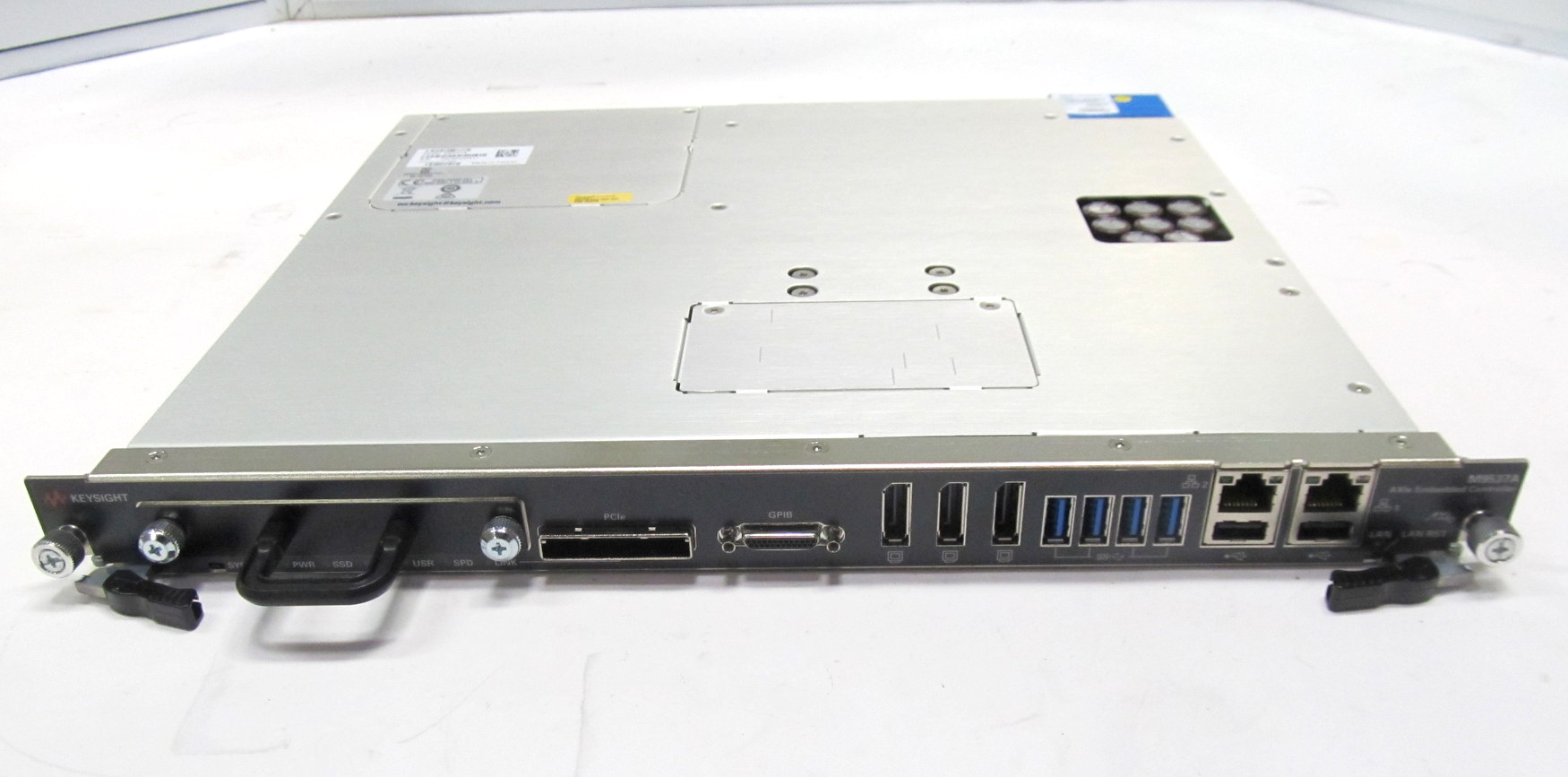


Keysight Technologies U4164A
Logic Analyzer Module
Rent or Lease • Buy Used From $101,500
The Keysight U4164A logic analyzer module introduces two new modes of operation: quad sample state mode and 10 GHz quarter channel timing mode. Quad sample state mode achieves four different sample positions at two independently adjusted thresholds from a single probe point on each input. Quad sample state mode means less space is required to probe high data rate signals such as LPDDR4 and DDR4 that require different sample positions for read and write data and separate rising edge/falling edge samples for data rates greater than 2.5 Gb/s. Quarter channel (10 GHz) timing mode provides up to 1.6 Gb samples per input.
In addition to the new modes of operation, the Keysight U4164A logic analyzer module includes multiple new features to help high-speed digital and DDR/LPDDR memory design engineers accelerate turn-on and debugging their systems. New features include a timing mode de-skew control, dual thresholds in dual sample state mode, clock hysteresis control to adjust the state mode sensitivity to noise on a clock inputs that floating while the clock is off, and a deep memory option of 400 Mb full channel, 800 Mb half-channel, and 1.6 Gb in quarter-channel.
The Keysight formerly Agilent U4164A logic analyzer module is available for rent or lease at TRS-RenTelco. We have an experienced team of metrologists and technicians that calibrates every product to stringent standards in our 50 GHz ANSI/NCSL Z540-1 compliant laboratory. Contact us to know more or request a quote today.
- Configurations
- Resources
- FAQsAI
--, 02G
See Configuration Details
-
02G
Increase maximum speeds: State to 4 Gb/s (2.5 GHz) and timing to 10 GHz
Standard Rental Accessories*
* Leased or Buy Used product accessories will be confirmed with quote.
-
Manual Quick Start Guide USB
Qty: 1
*This item has already been added to your cart. Check your cart for quantity and availability.
--, 016, 02G
See Configuration Details
-
016
Increase acquisition Memory Depth to 16 Mb
-
02G
Increase maximum speeds: State to 4 Gb/s (2.5 GHz) and timing to 10 GHz
Standard Rental Accessories*
* Leased or Buy Used product accessories will be confirmed with quote.
-
Manual Quick Start Guide USB
Qty: 1
*This item has already been added to your cart. Check your cart for quantity and availability.
--, 02G
See Configuration Details
-
02G
Increase maximum speeds: State to 4 Gb/s (2.5 GHz) and timing to 10 GHz
Standard Rental Accessories*
* Leased or Buy Used product accessories will be confirmed with quote.
-
Manual Quick Start Guide USB
Qty: 1
*This item has already been added to your cart. Check your cart for quantity and availability.
Base Model
Standard Rental Accessories*
* Leased or Buy Used product accessories will be confirmed with quote.
-
Manual Quick Start Guide USB
Qty: 1
*This item has already been added to your cart. Check your cart for quantity and availability.
--, 016, 700
See Configuration Details
-
016
Increase acquisition memory depth to 16 Mb
-
700
IIncrease maximum state speed to 700 MHz
Standard Rental Accessories*
* Leased or Buy Used product accessories will be confirmed with quote.
-
Manual Quick Start Guide USB
Qty: 1
*This item has already been added to your cart. Check your cart for quantity and availability.
--, 016, 02G
See Configuration Details
-
016
Increase acquisition Memory Depth to 16 Mb
-
02G
Increase maximum speeds: State to 4 Gb/s (2.5 GHz) and timing to 10 GHz
Standard Rental Accessories*
* Leased or Buy Used product accessories will be confirmed with quote.
-
Manual Quick Start Guide USB
Qty: 1
*This item has already been added to your cart. Check your cart for quantity and availability.
--, 02G, B4661A-1FP, U4164A-004
See Configuration Details
-
02G
Increase maximum speeds: State to 4 Gb/s (2.5 GHz) and timing to 10 GHz
-
B4661A-1FP
DDR/2/3/4 Listing Decoder, fixed perpetual license
-
U4164A-004
Increase acquisition memory depth to 4 Mb
Standard Rental Accessories*
* Leased or Buy Used product accessories will be confirmed with quote.
-
Manual Quick Start Guide USB
Qty: 1
*This item has already been added to your cart. Check your cart for quantity and availability.

Datasheet - Keysight Technologies U4164A
User Manual - Keysight Technologies U4164A
Content is AI-generated. Verify critical details with manufacturer-provided resources.
What type of instrument is the Keysight U4164A?
The U4164A is a logic analyzer module designed for use in Keysight AXIe chassis such as the M9502A portable 2-slot chassis and Digital Test Console chassis like the U4002A. It is also compatible with 16850-series logic analyzers and supports remote access over networks as well as offline analysis on Windows computers for debugging and validation of digital systems.
What sampling modes does the U4164A logic analyzer support?
The U4164A supports two primary sampling modes: timing mode for asynchronous sampling using an internal sampling clock, and state mode for synchronous sampling using the device under test's clock signal. Timing mode is ideal for timing diagrams and signal integrity analysis, while state mode captures data synchronously with the system clock for functional analysis of processor buses.
What triggering capabilities does the U4164A offer for capturing specific events?
The U4164A offers advanced triggering capabilities including sequence steps with boolean expressions, edges, ranges, flags, counters, and timers. It supports storage qualification for selective data capture, multiple trigger branches, and cross-module triggering. Engineers can specify triggers using quick draw-box triggers in the waveform window, simple pattern-based triggers, or complex multi-step advanced trigger sequences.
What data analysis and display capabilities does the U4164A provide?
The U4164A provides analysis through multiple synchronized display modes: waveform display for timing diagrams with overlay and chart views, listing display for state table data, compare display for reference data comparison, source display for correlating captured data with source code, and protocol viewer for packet analysis. Markers allow precise time and sample interval measurements between data points.
Does the U4164A support protocol decode and packet analysis?
Yes, the U4164A includes a protocol viewer for analyzing packet-level data from communication buses. It provides packet summary views, detailed single-packet inspection, event color coding for quick identification, and customizable column properties. The protocol viewer window supports filtering and searching within decoded packet streams to help engineers verify protocol compliance and debug bus-level communication issues.
What file formats does the U4164A support for saving and exporting captured data?
The U4164A supports multiple export formats including standard CSV files for spreadsheet analysis, module-specific CSV files with detailed channel information, and module binary ALB format files for efficient storage. Configuration files can be saved in ALA or XML formats, preserving both instrument setup and captured data. Data import modules allow loading data from external sources for analysis within the logic analyzer environment.
How does the U4164A handle memory depth and channel count trade-offs?
The U4164A features configurable memory depth and channel count with trade-offs between the two parameters. Users can allocate more memory per channel for longer captures of fewer signals, or use more channels with reduced memory depth for wider bus monitoring. Transitional timing mode can further extend effective memory depth by storing data only when signal transitions occur rather than at every sample clock.
Does the U4164A support remote access and multi-user collaboration?
Yes, the U4164A supports remote access over the network, allowing engineers to connect to logic analysis systems from a separate Windows computer. The software includes a system browser for discovering available analyzers, system-in-use comments for team coordination, and a built-in chat function for communicating with other connected users. Password protection can be configured for secure remote access to shared instruments.