

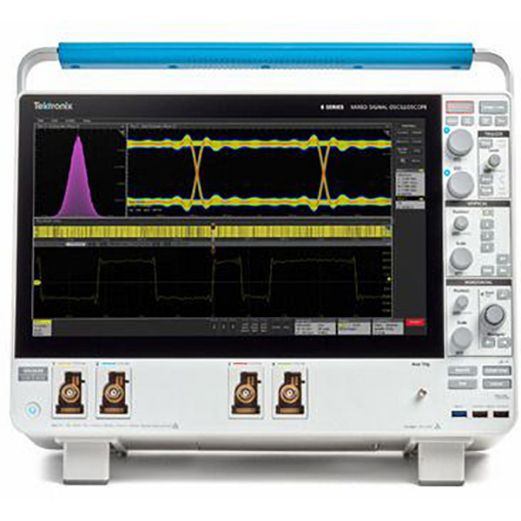
Tektronix MSO64-6-BW4000
4 Ch 4 GHz Oscope
Rent or Lease
More speed, less noise, excellent signal fidelity, and exceptional measurement capabilities define the Tektronix MSO64 6-BW-4000 mixed signal oscilloscope.
Troubleshoot and validate high-speed designs now and into the future with upgradeable bandwidth that goes up to 8GHz. Get accurate measurements with low noise and 25 GS/s sample rate per channel. The sample rate does not drop as you turn on the channels.
The MSO64 6-BW-4000 improves measurement confidence with new levels of signal detail and exceptional signal fidelity for analysis and debug of embedded systems. It saves you time, protects investments, and comes with new high-performance probe options. This Tektronix MSO also has an optional Windows OS and comes with a short user-interface tutorial and user-friendly menus.
Tektronix MSO64 6-BW-4000 Features and Specifications:
- Bandwidth: 4GHz , upgradeable up to 6GHz and 8GHz
- Real-time sample rate: 25 GS/s (on four channels)
- Full high-definition resolution (1,920 x 1,080/396mm display)
- 15.6-inche capacitive touchscreen with pinch-zoom-swipe features
- 62.5M record length (upgradable to 125M/250M)
- FlexChannels: Four
- Decode and trigger support options
- Advanced power analysis options
- Three-year warranty
The Tektronix MSO64 6-BW-4000 mixed signal oscilloscope is available for rent or lease at TRS-RenTelco. Call us at 800.874.7123 for more information.
- Configurations
- Resources
- FAQsAI
Base Model
Standard Rental Accessories*
* Leased or Buy Used product accessories will be confirmed with quote.
-
Cord Power
Qty: 1 -
Mouse Optical
Qty: 1 -
Probe
Qty: 4 -
Manual Set
Qty: 1 -
Cover Front
Qty: 1 -
Accessory Pouch
Qty: 1 -
Marker Band Set Probe Identification 2 Each Of 5 Colors
Qty: 1
*This item has already been added to your cart. Check your cart for quantity and availability.

Datasheet - Tektronix Mixed Signal Oscilloscope 6 Series
User Manual - Tektronix Mixed Signal Oscilloscope 6 Series

Video - Tektronix Introducing the 6 Series MSO
Content is AI-generated. Verify critical details with manufacturer-provided resources.
What are the key performance specifications of the Tektronix 6 Series MSO64 with 4 GHz bandwidth?
The MSO64 4 GHz model delivers 25 GS/s real-time sample rate across all channels with 62.5 Mpoints standard record length (upgradable to 125 or 250 Mpoints). It features 4 FlexChannel inputs with 12-bit ADCs providing up to 16-bit vertical resolution in High Res mode. The instrument achieves industry-leading low noise performance with typical RMS noise of 97.4 uV at 1 mV/div and 192 uV at 10 mV/div settings at 4 GHz bandwidth.
How does the TEK061 front end amplifier improve signal fidelity on the MSO64?
The TEK061 ASIC front end amplifier sets a new standard for low-noise acquisition, providing breakthrough noise performance at high sensitivity settings. At 4 GHz bandwidth and 10 mV/div, the MSO64 achieves 192 uV RMS noise compared to 500 uV on previous-generation oscilloscopes. This lower noise floor is critical for viewing fine signal details on small, high-speed signals prevalent in GHz-speed bus topologies and enables more accurate characterization of signal integrity.
What is Visual Trigger and how does it accelerate debugging on the 6 Series MSO?
Visual Trigger extends the oscilloscope's triggering capabilities by scanning waveform acquisitions and comparing them to on-screen geometric shapes (triangles, rectangles, hexagons, or trapezoids) that you draw using the touchscreen or mouse. You can create an unlimited number of trigger areas and combine them with Boolean logic equations to isolate complex signal events. This can save hours of manual acquisition review by triggering only on specific events of interest across single or multiple channels.
Does the MSO64 support both dedicated and Windows operating modes?
Yes, the 6 Series MSO64 allows you to choose whether to include a Windows operating system via a removable solid-state drive accessed through a panel on the bottom of the instrument. Without the SSD, the instrument boots as a dedicated oscilloscope. With the optional Windows 10 SSD installed, you can minimize the oscilloscope application to access a Windows desktop for installing additional applications or connecting external monitors, while maintaining identical oscilloscope operation and user interface.
What serial compliance testing options are available for the MSO64?
The MSO64 supports optional serial compliance testing for Ethernet, USB 2.0, Automotive Ethernet, and MIPI D-PHY 1.2. These automated compliance solutions configure pass/fail mask and measurement limit testing according to industry standards. The instrument also offers optional serial bus triggering, decode, and analysis for protocols including I2C, SPI, RS-232/422/485/UART, SPMI, CAN, CAN FD, LIN, FlexRay, SENT, USB 2.0, Ethernet, Audio, MIL-STD-1553, and ARINC 429.
What makes the TDP7700 Series TriMode probes ideal for the 6 Series MSO64?
The TDP7700 Series TriMode probes provide the highest probe fidelity available for real-time oscilloscopes through full AC calibration based on unique S-parameter models. The probes communicate S-parameters to the MSO64 via the TekVPI interface, and the oscilloscope applies them to achieve optimal signal fidelity from probe tip to acquisition memory. TriMode capability enables differential, single-ended, and common mode measurements with one probe setup, allowing you to switch between measurement modes without moving the probe connection.
What DDR memory analysis capabilities does the 6 Series MSO offer?
The optional DDR3 debug and analysis package automatically identifies DDR3 reads and writes and performs JEDEC conformance measurements with pass/fail results on all edges in every read and write burst. It provides measurement capabilities for clock, address, and control signals. When combined with DPOJET jitter analysis, this becomes the fastest way to debug complex memory signaling issues, offering both conformance testing and deep signal integrity analysis.
How does the MSO64 handle long record acquisitions with the Wave Inspector controls?
The 6 Series MSO64 features innovative Wave Inspector controls with a unique force-feedback system that enables rapid panning and zooming through records containing up to 250 Mpoints. You can move from one end of the record to the other in seconds using the controls, or use intuitive drag and pinch/expand touchscreen gestures. The Search feature automatically locates user-defined events such as edge, pulse width, timeout, runt, window, logic, setup/hold, rise/fall time, and serial bus packets, marking all occurrences for easy navigation.